Mirror aluminiumplaten zijn op grote schaal gebruikt in verschillende toepassingen vanwege hun superieure reflecterende eigenschappen en duurzaamheid. Inzicht in het belang van reflectiviteit voor spiegelaluminiumplaten is cruciaal voor fabrikanten, ontwerpers, en gebruikers. Dit artikel onderzoekt de rol van reflectiviteit in spiegelaluminiumplaten, De impact ervan op de prestaties, en de betekenis ervan in verschillende industrieën.
The Definition and Measurement of Reflectivity
Reflectiviteit, in the context of mirror aluminum plates, refers to the ratio of reflected light to the incident light falling onto the surface. It is typically measured using a spectrometer or a reflectometer, which quantifies the amount of light reflected at specific wavelengths. Reflectivity is expressed as a percentage or decimal fraction, with higher values indicating greater reflectivity.
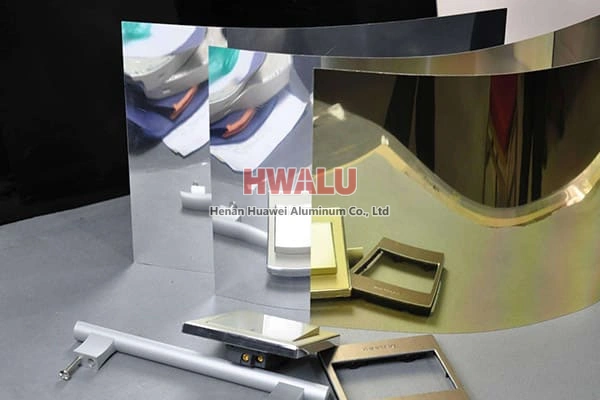
Factors Affecting Reflectivity in Mirror Aluminum Plates
Several factors influence the reflectivity of mirror aluminum plates:
- Oppervlakteafwerking: A smooth, polished surface enhances reflectivity by reducing scattering losses.
- Alkali resistance: Coatings like sodium silicate and fluoropolymer enhance alkali resistance and maintain reflectivity over time.
- Dikte: Thicker plates can sometimes have better reflectivity due to less substrate surface distortion which can scatter light.
- Alloy composition: Certain alloy compositions, such as 1xxx series aluminum, offer high reflectivity due to their purity and absence of alloying elements that can affect optical properties.
Significance of High Reflectivity in Mirror Aluminum Plates
High reflectivity in mirror aluminum plates is crucial for several reasons:
- Enhanced performance: Applications such as solar reflectors, signal mirrors, and decorative panels require maximum light reflection to function optimally.
- Energy efficiency: High reflectivity reduces energy loss in thermal radiation systems, zonnecollectoren, and lighting solutions.
- Esthetiek: In decorative applications, higher reflectivity provides a clearer, distortion-free reflection, which is aesthetically pleasing.
- Duurzaamheid: Alkali-resistant coatings and high-quality surface finishes ensure long-term reflectivity and reduce maintenance needs.

Comparing Mirror Aluminum Plate Reflectivity to Other Materials
| Materiaal |
Reflectiviteit (%) |
Comments |
| Spiegel aluminium plaat |
90-98 |
Highest among metals, with alkali-resistant coatings |
| Roestvrij staal (Gepolijst) |
60-70 |
Lower reflectivity than aluminum, affected by oxidation |
| Glazen spiegel |
92-94 |
High reflectivity but prone to scratches and fractures |
| Copper Mirror |
95-97 |
Higher reflectivity than aluminum but less durable |
| Verzilverd glas |
98+ |
Highest theoretical reflectivity, but less practical due to fragility |
Toepassingen van spiegelaluminiumplaten

- Zonne-reflectoren: Reflectivity plays a critical role in maximizing solar energy capture for heating, cooling, and power generation systems.
- Architectural Panels: Mirror aluminum plates are used in façade cladding, aanmaak, and decorative elements to reflect sunlight and improve aesthetics.
- Optical Systems: Light-weight and durable mirror aluminum plates are used in various instrumentation and imaging systems.
- Traffic Signs and Signals: High reflectivity ensures better visibility and safety in low-light conditions.
- Vehicle Parts: Reflectors in tail lights, headlights, and side panels improve overall vehicle safety.
- Art and Creative Installations: Artistically designed aluminum mirrors are used to create innovative visual effects.

Performance Data and Benchmarks
- Mirror aluminum plates can achieve a reflectivity of 95% or higher in visible light (400-700 nm).
- Reflectivity in the infrared (IR) range (700-2500 nm) kan overschrijden 90% for certain alloys and finishes.
- Alkali-resistant coatings can maintain reflectivity within 90% even after 1000 hours of exposure to concentrated NaOH solutions.
- Mirror aluminum plates can withstand average temperatures up to 200°C (392°F) without significant drop in reflectivity.
Future Trends and Advancements
- Innovations in coating technology: New coatings that combine high reflectivity, duurzaamheid, and cost-effectiveness are being developed.
- Nano-engineering: Surface textures and nano-coatings are being explored to enhance reflectivity and functionality, such as self-cleaning and anti-fog properties.
- Light-weighting: Thinner, lighter aluminum alloys with high reflectivity will enable new applications in aerospace, automotive, and portable equipment.
- Smart coatings: Thermochromic and photochromic coatings that dynamically adjust reflectivity based on environmental conditions are being researched.
Conclusie
The significance of reflectivity to mirror aluminum plates cannot be overstated. It directly impacts performance, energie -efficiëntie, duurzaamheid, and aesthetics across a wide range of applications. With ongoing advancements in materials science and coating technologies, mirror aluminum plates continue to offer unparalleled value in reflective surfaces. By understanding the factors influencing reflectivity and selecting appropriate products for specific needs, manufacturers, ontwerpers, and users can maximize the benefits of these remarkable materials. As the demand for efficient, duurzaam, and visually appealing reflective surfaces grows, mirror aluminum plates will undoubtedly remain at the forefront of innovation.
References:
- ASTM G133 - Standard Test Method for Reflectance of Materials Using Integrating Spheres, ASTM International, West Conshohocken, PA, 2022.
- Genc, M. et al. (2019). High Reflective Aluminum Coatings forThermal Protection of Reinforced Concrete Structures, Applied Sciences, 9(5), 978.
- Wang, H., & Wei, Z. (2008). Prolonging the Reflectivity of Aluminum Mirrors by Conversion Coatings, Materials and Manufacturing Processes, 23(3), 266-272.
- Tunberg, E. (2010). Light Reflection Materials and Articles, US Patent No. US20100008267 A1.
- International Aluminum Institute (IAI). Aluminum in Solar Reflectors, London: IAI, 2015.
- Kurlov, B., & Fedoseev, K. (2018). Modelling of Reflectivity and Selective Light Transmission in Lightweight Structures for Facades, Procedia Engineering, 198, 885-891.